Earn 2.5% p.a. interest on your Uniplus Account when you invest or insure with us.
Now enhanced to make your money work harder as you save and invest or insure with UOB. Subject to qualifying criteria. T&Cs apply. SGD deposits are insured up to S$100k by SDIC.
Explore UOB's range of savings accounts and credit cards designed around your banking needs. Get started by entering your friend's referral code here. Subject to qualifying criteria. T&Cs apply.
CPF nomination in Singapore: What it covers and how to make one
Plan
12 Oct 2026
8 min read
You are now reading:
CPF nomination in Singapore: What it covers and how to make one
Summary
A CPF nomination lets you decide who receives your CPF savings after your passing.
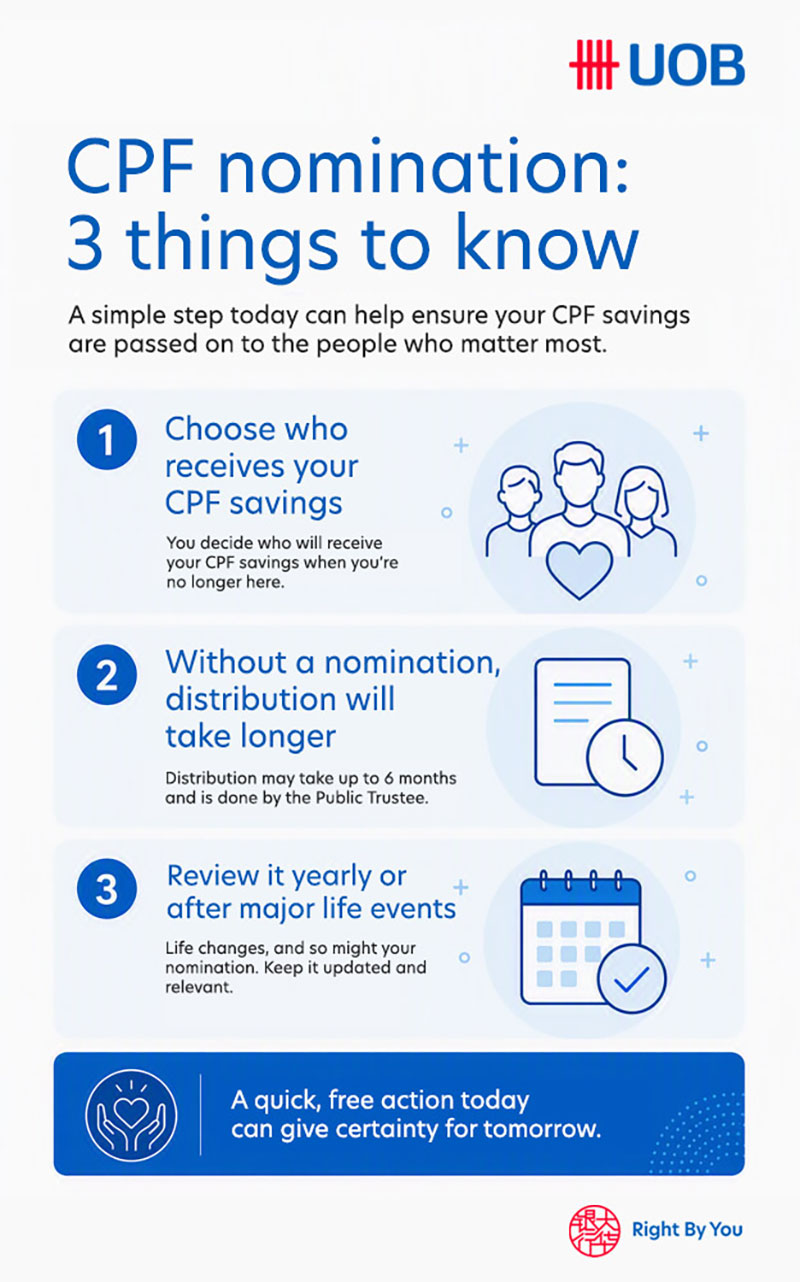
Without one, your CPF savings will be distributed by the Public Trustee, which may take longer and may not reflect your wishes.
Making a nomination and reviewing it regularly ensures your savings are distributed as you intend and gives your loved ones greater clarity.
Making a CPF nomination is quick, free and often overlooked. Find out how it can give your loved ones clarity and reduce future administrative hassle.
Most people spend more time hunting for deals or deciding what to eat for lunch than thinking about what will happen to their money when they are no longer around.
That's understandable. CPF nomination isn't exactly dinner-table conversation. It sits somewhere between updating your insurance beneficiaries and writing a will: important, but easy to put off for another day.
The problem is that "another day" has a habit of becoming next year, or the year after that.
Yet making a CPF nomination is one of the quickest and simplest financial housekeeping tasks you can complete. It's also free. Without one, you would not have a say in who should receive your CPF savings after your passing, and it may take longer for your loved ones to receive the money1.
If you've been meaning to get around to it someday, here's why someday should probably be sooner rather than later.
What is a CPF nomination and why should I make one?
A CPF nomination lets you decide who receives your CPF savings when you pass away, and what share each person receives. By making a nomination, you are making sure your wishes on how your CPF savings are distributed will be carried out. Similar to making a will, leaving clear instructions on what should be done with your CPF savings can prevent misunderstandings among family members.
Some people may assume their family members will automatically receive their CPF savings. Others may think they don’t need to make a separate CPF nomination if they already have a will. However, your CPF savings cannot be included in a will and do not form part of your estate – more on that later.
What happens if I die without a CPF nomination?
While your CPF savings will still be distributed after your death, the process can become more tedious for those left behind.
Without a CPF nomination, your CPF savings will be distributed by the Public Trustee according to the relevant intestacy laws (for non-Muslims) or inheritance certificate (for Muslims).
This means the money may not go where you would have intended. Upon notification of your death, the Public Trustee would need to identify surviving family members who are eligible to claim as beneficiaries under the relevant laws. This process can take up to six months and an administrative fee is charged.
Making a CPF nomination is free, and there are no fees charged when CPF Board distributes your CPF savings to your nominees.
Now imagine your family during that period.
They may already be coping with grief, handling funeral arrangements, managing estate matters and adjusting to significant life changes. Additional administrative processes would be the last thing they want to deal with.
A CPF nomination does not eliminate all estate-related matters, but it can help make one aspect of the process more straightforward – something your family would truly be thankful for.
Why some people put off making their CPF nomination
Here, we look at some common reasons why people delay making their CPF nomination – and why they shouldn’t.
"I'm still young. Do I really need one?"
If you're young or have only just started working, we understand — it may not feel like a priority right now. After all, CPF and legacy planning can sound like things meant for retirees, wealthy individuals or people approaching major life milestones.
But the reality is that CPF savings start accumulating from your very first salary. In fact, those as young as 16 years can start making a nomination.
"I don't have much CPF savings."
Many young adults have relatively modest CPF balances. But CPF savings generally grow throughout a person's working life. Thanks to compound interest, as your career progresses, the amount involved may become far more significant than you expect.
"My family already knows what I want."
Maybe they do.
But verbal conversations can be forgotten, misremembered or interpreted differently by different people. Also, as your CPF savings will be distributed according to intestacy laws or a Muslim Inheritance Certificate – the legal end result may be quite different from what you envisioned.
"I already have a will."
A will is an important estate-planning document. However, it does not cover your CPF savings.
This arrangement protects your CPF savings from creditor claims tied to outstanding loans that you may have, and as such, your CPF savings are preserved fully for your loved ones2.
There is also a practical difference. Assets distributed through a will require going through the probate process, which typically takes three to six months and may involve legal costs. With a valid CPF nomination, CPF Board will notify nominees to claim the savings within 10 working days after it is notified of your passing.
"I'll do it eventually."
The uncomfortable truth is, life doesn't always run according to schedule.
None of us can predict an accident, sudden illness or unexpected event. That's precisely why planning – and taking action – matter.
Legacy planning isn't just about preparing for old age. It's about giving yourself and your loved ones certainty, regardless of when life circumstances change.
What does a CPF nomination cover?
One might assume a CPF nomination covers all the things their CPF savings can be used for, like housing and investments, but this is not the case.
A CPF nomination covers:
CPF savings in your Ordinary Account (OA), Special Account (SA), MediSave Account (MA), and Retirement Account (RA)
Unused CPF LIFE premiums
Discounted Singtel shares3 (for designated CDP accounts only from 22 Nov 2026)
A CPF nomination does not cover:
Properties bought using CPF savings: If your property is owned under Joint Tenancy, your share will be transferred to the surviving owner(s), but if it is under Tenancy-in-Common, the share will form part of your estate
Dependants' Protection Scheme (DPS) payouts
Investments under the CPF Investment Scheme (CPFIS): These form part of your estate. However, for insurance policies, any death benefits will be paid to your nominated beneficiaries if you have made a nomination with the insurer
You may visit CPF’s website for more details on how the latter items will be handled instead.
How do I make a CPF nomination?
First, find some space and time to think about how you’d like your CPF savings to be distributed.
If you are a parent and want to nominate your child, do bear in mind that if your child is younger than 18 when you pass away, his/her share will be transferred to the Public Trustee and held in trust until they turn 18. If your goal is to support day-to-day family needs, this is something to think through carefully.
Method 1: Online nomination service (Recommended)
For most, doing it online is the quickest and easiest option.
Get the details ready: Have your nominees’ full names, NRIC or identification numbers and contact details on hand. You’ll also need the full names, NRIC and contact details of two witnesses who are at least 21 years old, of sound mind, have Singpass and are not your nominees.
Fill in your nomination: Enter your nominees and the percentage each person should receive. Make sure the total adds up to 100%, then add your witnesses’ details and submit.
Inform your witnesses to verify it: Your witnesses will receive an SMS or email notification regarding your nomination. Ask your witnesses to log in and confirm within seven days that the nomination was made of your own free will. Witnesses will not be able to see your nomination details.
Method 2: In-person at a CPF Service Centre
If online nomination is not an option, you can do it in person at a CPF Service Centre.
Book an appointment: Make an appointment at least one working day in advance.
Bring the right documents: Bring your identification card or passport, along with photocopies of your nominees’ identification documents.
Complete the form: CPF officers will witness your nomination at the Service Centre.
Don't forget to review it
Making a CPF nomination is not a one-time exercise that should be forgotten forever.
Life changes. The nomination that made perfect sense when you were 30 may no longer reflect your wishes at 40 or 50.
Make it a habit to review nominations regularly, particularly following major life events such as marriage, childbirth, divorce or the death of a nominee.
Better yet, review your nomination yearly during your annual financial check-up. If you're already reviewing your insurance coverage, savings goals and investment portfolio, it only takes a few additional minutes to ensure your CPF nomination still reflects your wishes. You can review your CPF nomination at cpf.gov.sg/ViewNOMDetails with your Singpass.
Does marriage revoke a CPF nomination?
One life event deserves special attention: marriage.
Marriage automatically revokes any existing CPF nomination. If you and your partner have just tied the knot, do make a new CPF nomination so that your CPF savings can continue to be distributed in accordance with your intentions.
(However, a divorce does not revoke a CPF nomination – one example why nominations should be reviewed regularly.)
Conclusion
Making a CPF nomination may not feel urgent today, but it is one of those simple financial housekeeping tasks that can make a meaningful difference later. It helps ensure your CPF savings are distributed according to your wishes, reduces guesswork for your loved ones and gives them one less administrative matter to handle during a difficult time.
If you have not made a CPF nomination, or have not reviewed yours in a while, consider setting aside a few minutes to do so. It is a small action that can provide invaluable clarity in the future.
This publication is for general information and general circulation only and does not have any regard to the specific investment objectives, financial situation and particular needs of any specific person.
The information contained in this publication is based on publicly available information as at 12 October 2026 and remains subject to change at any time without notice. United Overseas Bank Limited (“UOB”) shall not be under any duty or obligation to update or correct the information contained in this publication. Accordingly, UOB and its directors, officers, employees and affiliates make no representation or warranty of any kind (express, implied or statutory) and shall not be responsible or liable for the completeness or accuracy of the information contained in this publication. UOB and its directors, officers, employees and affiliates accept no liability for any error, inaccuracy, omission or any consequence of loss howsoever suffered by any person, arising from any reliance on the information in this publication.
Nothing in this publication constitutes accounting, legal, regulatory, tax, financial or other advice. You are solely responsible for carefully assessing the relevance and accuracy of the contents of the materials for your own needs. Reliance should not be placed on the contents of this publication to make any investment or financial decisions. You should always consult your own legal, tax, financial, or other professional advisors before making any financial or investment decisions or entering into any transaction.